


Plaque Wording:
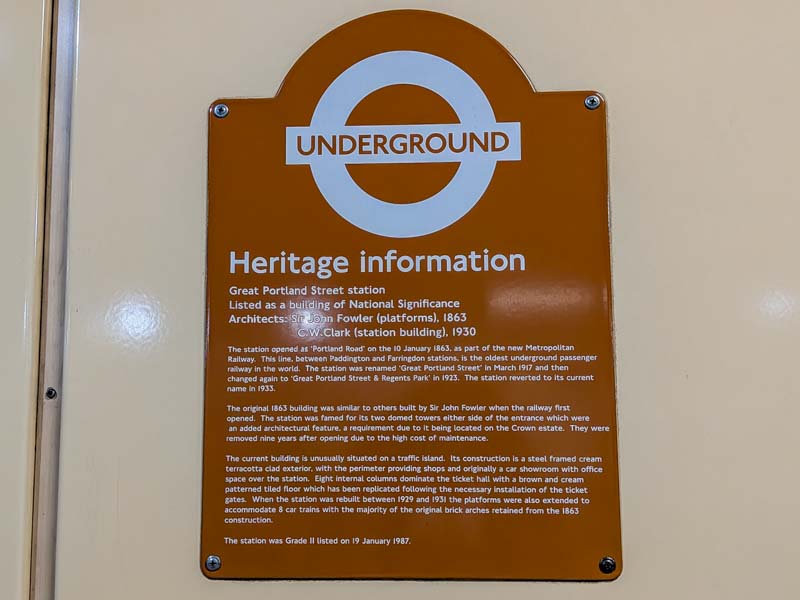
Great Portland Street station
Listed as a building of national significance
Architects: Sir John Fowler (platforms), 1863 C. W. Clark (station building), 1930
The station opened as 'Portland Road' on the 10 January 1863, as part of the new Metropolitan Railway. This line, between Paddington and Farringdon stations, is the oldest underground passenger railway in the world. The station was renamed 'Great Portland Street' in March 1917 and then changed again to 'Great Portland Street & Regents Park' in 1923. The station reverted to its current name in 1933.
The original 1863 building was similar to others built by Sir John Fowler when the railway first opened. The station was famed for its two domed towers either side of the entrance which were an added architectural feature, a requirement due to it being located on the crown estate. They were removed nine years after opening due to the high cost of maintenance.
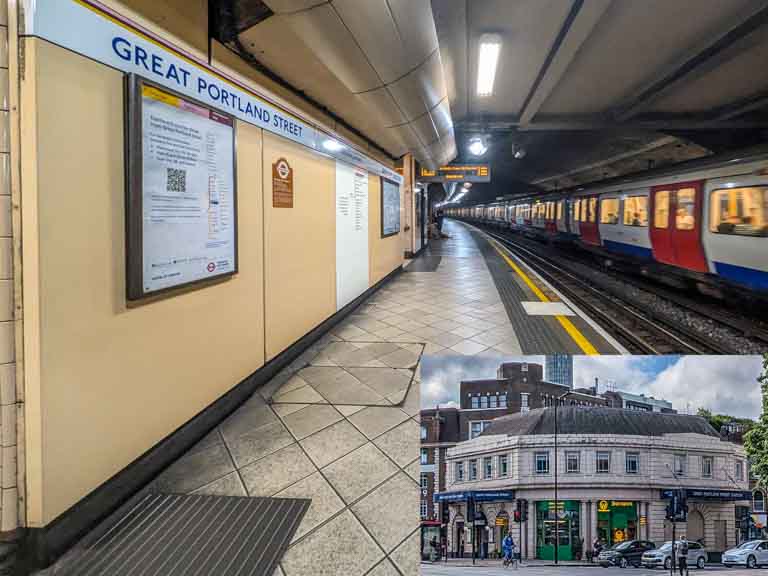
The current building is unusually situated on a traffic island. Its construction is a steel framed cream terracotta clad exterior, with the perimeter providing shops and originally a car showroom with office space over the station. Eight internal columns dominate the ticket hall with a brown and cream patterned tiled floor which has been replicated following the necessary installation of the ticket gates. When the station was rebuilt between 1929 and 1931 the platforms were also extended to accommodate 8 car trains with the majority of the original brick arches retained from the 1863 construction.
The station was Grade II listed on 19 January 1987.


Plaque Wording:
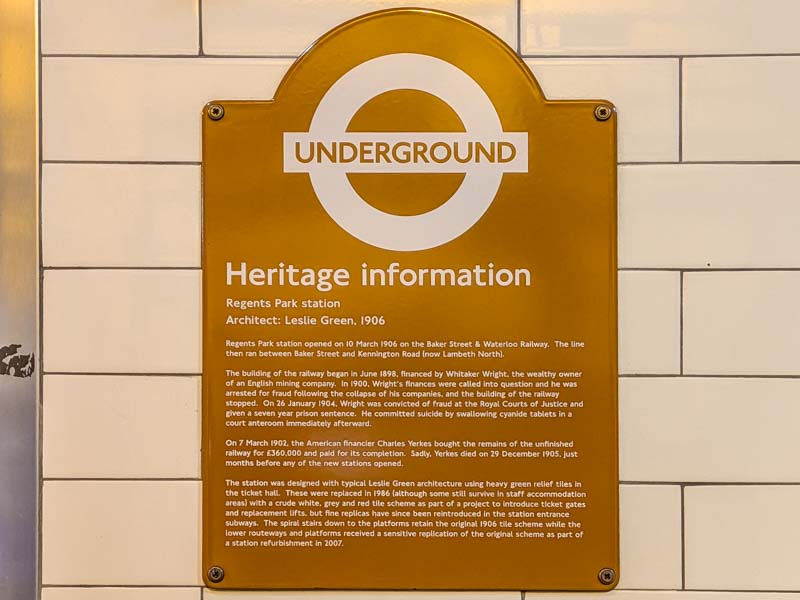
Heritage information Regents Park station
Architect: Leslie Green, 1906
Regents Park station opened on 10 March 1906 on the Baker Street & Waterloo Railway. The line then ran between Baker Street and Kennington Road (now Lambeth North).
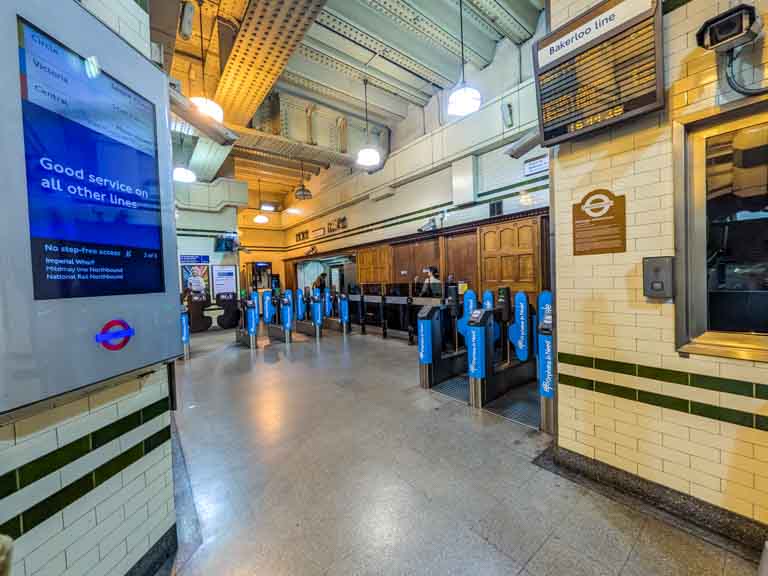
The building of the railway began in June 1898, financed by Whitaker Wright, the wealthy owner of an English mining company. In 1900, Wright's finances were called into question and he was arrested for fraud following the collapse of his companies, and the building of the railway stopped. On 26 January 1904, Wright was convicted of fraud at the Royal Courts of Justice and given a seven year prison sentence. He committed suicide by swallowing cyanide tablets in a court anteroom immediately afterward. On 7 March 1902, the American financier Charles Yerkes bought the remains of the unfinished railway for £360,000 and paid for its completion. Sadly, Yerkes died on 29 December 1905, just months before any of the new stations opened. The station was designed with typical Leslie Green architecture using heavy green relief tiles in the ticket hall. These were replaced in 1986 (although some still survive in staff accommodation areas) with a crude white, grey and red tile scheme as part of a project to introduce ticket gates and replacement lifts, but fine replicas have since been reintroduced in the station entrance subways. The spiral stairs down to the platforms retain the original 1906 tile scheme while the lower routeways and platforms received a sensitive replication of the original scheme as part of a station refurbishment in 2007.
The building of the railway began in June 1898, financed by Whitaker Wright, the wealthy owner of an English mining company. In 1900, Wright's finances were called into question and he was arrested for fraud following the collapse of his companies, and the building of the railway stopped. On 26 January 1904, Wright was convicted of fraud at the Royal Courts of Justice and given a seven year prison sentence. He committed suicide by swallowing cyanide tablets in a court anteroom immediately afterward. On 7 March 1902, the American financier Charles Yerkes bought the remains of the unfinished railway for £360,000 and paid for its completion. Sadly, Yerkes died on 29 December 1905, just months before any of the new stations opened. The station was designed with typical Leslie Green architecture using heavy green relief tiles in the ticket hall. These were replaced in 1986 (although some still survive in staff accommodation areas) with a crude white, grey and red tile scheme as part of a project to introduce ticket gates and replacement lifts, but fine replicas have since been reintroduced in the station entrance subways. The spiral stairs down to the platforms retain the original 1906 tile scheme while the lower routeways and platforms received a sensitive replication of the original scheme as part of a station refurbishment in 2007.


